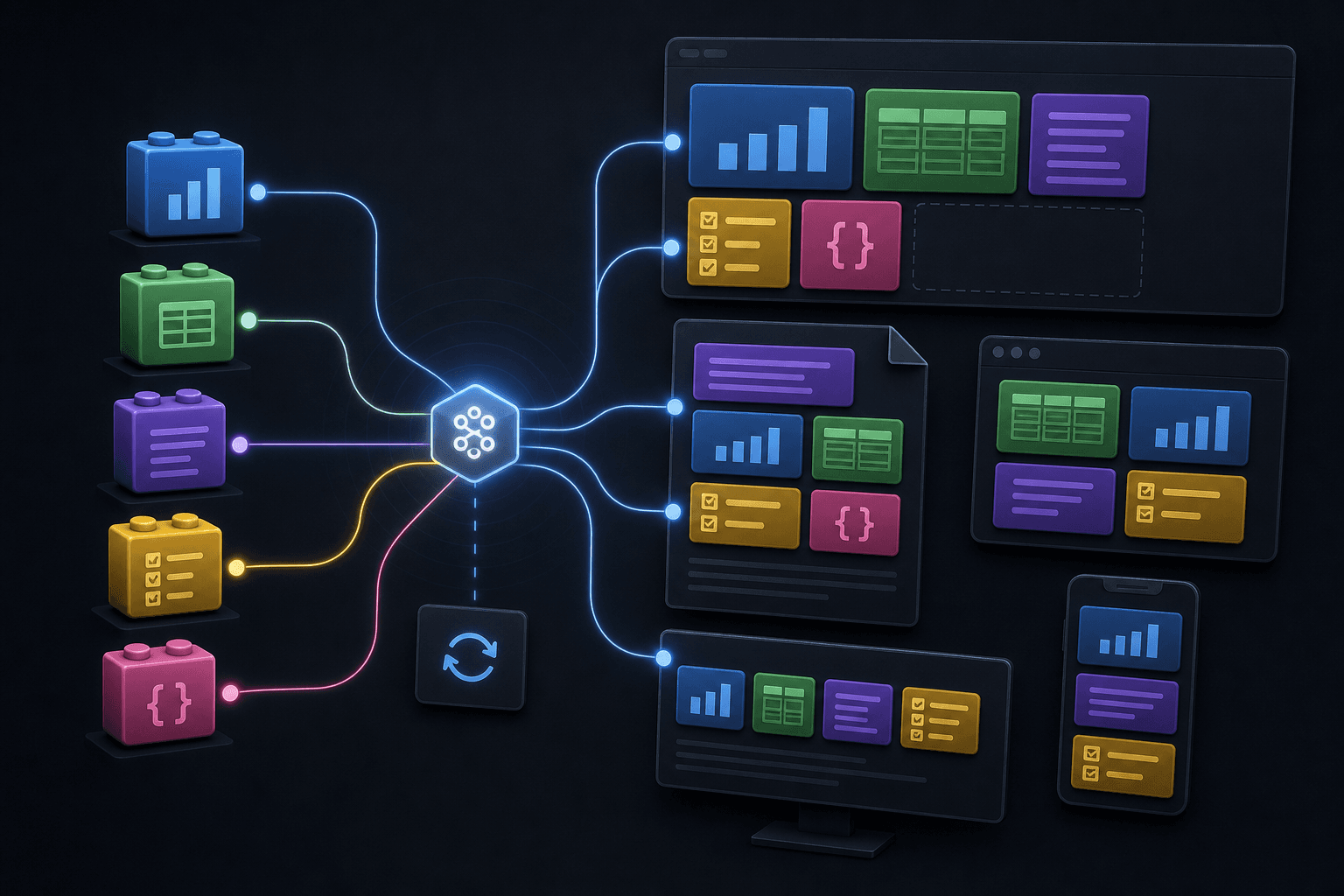
The atomic approach: Pins as the universal building block
Atomic Pins mean you can share an entire page or canvas AND share any single Pin inside it, reuse the same Pins across formats, and update once instead of retyping—plus AI that acts on real objects, not blobs.
Most tools make information live inside one format: a chart in a dashboard, a paragraph in a doc, a task in a board. When the audience changes, teams usually copy, paste, export, and rebuild the same story somewhere else.
Pindown’s atomic approach is simpler: treat each piece of information as a Pin—a small, typed, reusable block you can put into different formats without losing what it means.
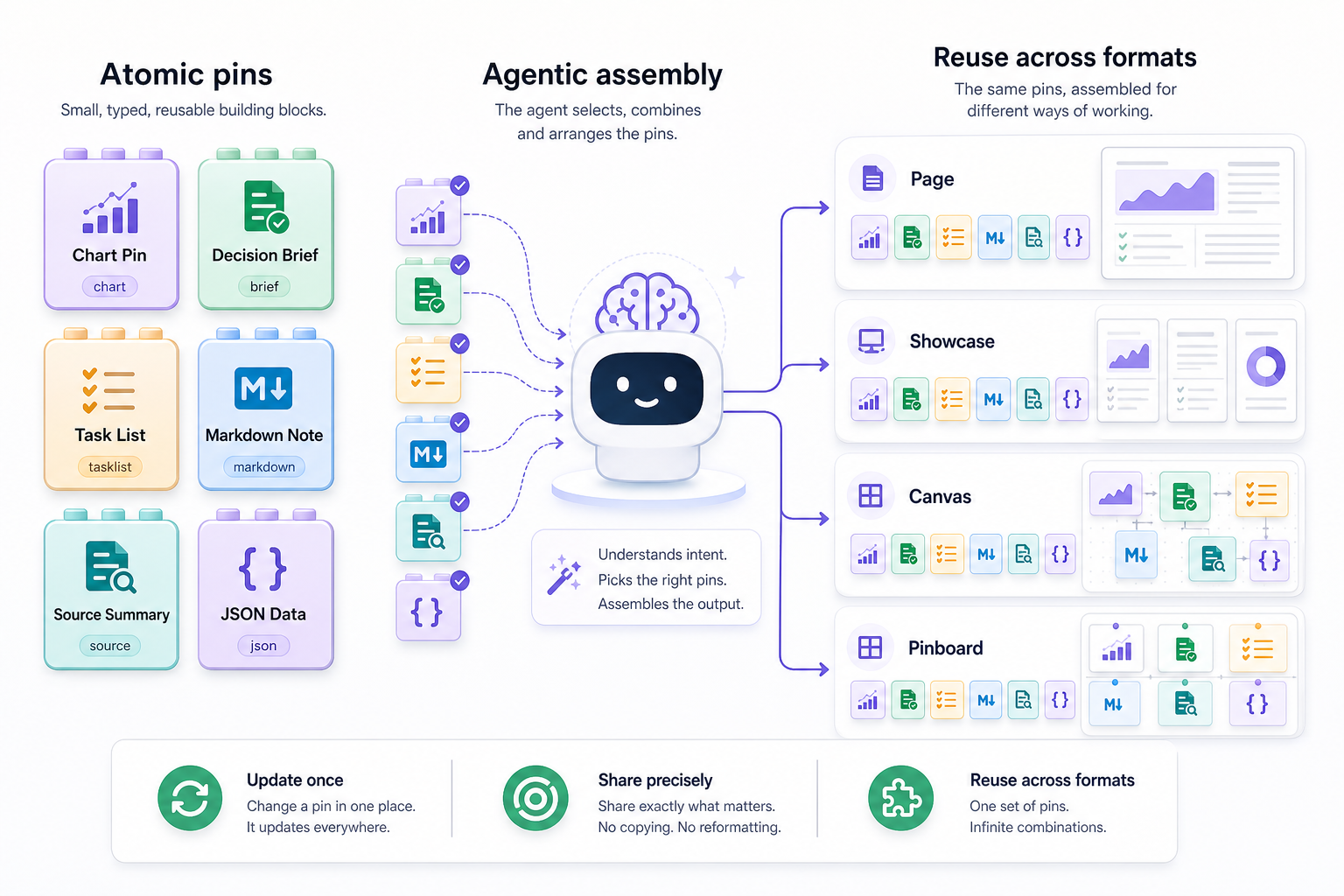
This also enables agentic assembly: imagine the agent picking the pins you need like Lego blocks and putting them into the format you asked for. You stop painfully describing which information to include or leave out; you think in pins, and the agent can assemble those blocks into the output.
The simple idea
A pin can be a chart, table, Markdown brief, JSON block, stat card, checklist, or another structured unit.
Instead of rebuilding the same information for every surface, you keep the pin as the source and place it where it belongs:
- on a canvas for visual thinking
- in a page for reading
- inside a showcase for presentation
- in a project for planning
- on a pinboard for sharing, review, comparison, or monitoring
Try it yourself — update the source pin and watch every surface follow:
Why that matters
| Advantage | What it means |
|---|---|
| Bite-size organization | Work is easier to arrange because information is broken into focused pins instead of giant documents. |
| Update once | Change the pin in one place and the formats using that pin can stay aligned. |
| Less duplicate information | No more retyping the same metric, brief, or table into every page, deck, and board. |
| Flexible formats | The same pin can support a planning view, a client view, a research page, or a visual canvas. |
| Precise sharing | Share the whole surface when the full story matters, or share only the specific pins someone needs. |
| Agent-ready structure | Agents act on named pins—not one long blob of text. |
The takeaway
Atomic pins are about simplification: smaller building blocks, less duplicated information, easier sharing, and one place to update the truth while still delivering it through many formats.