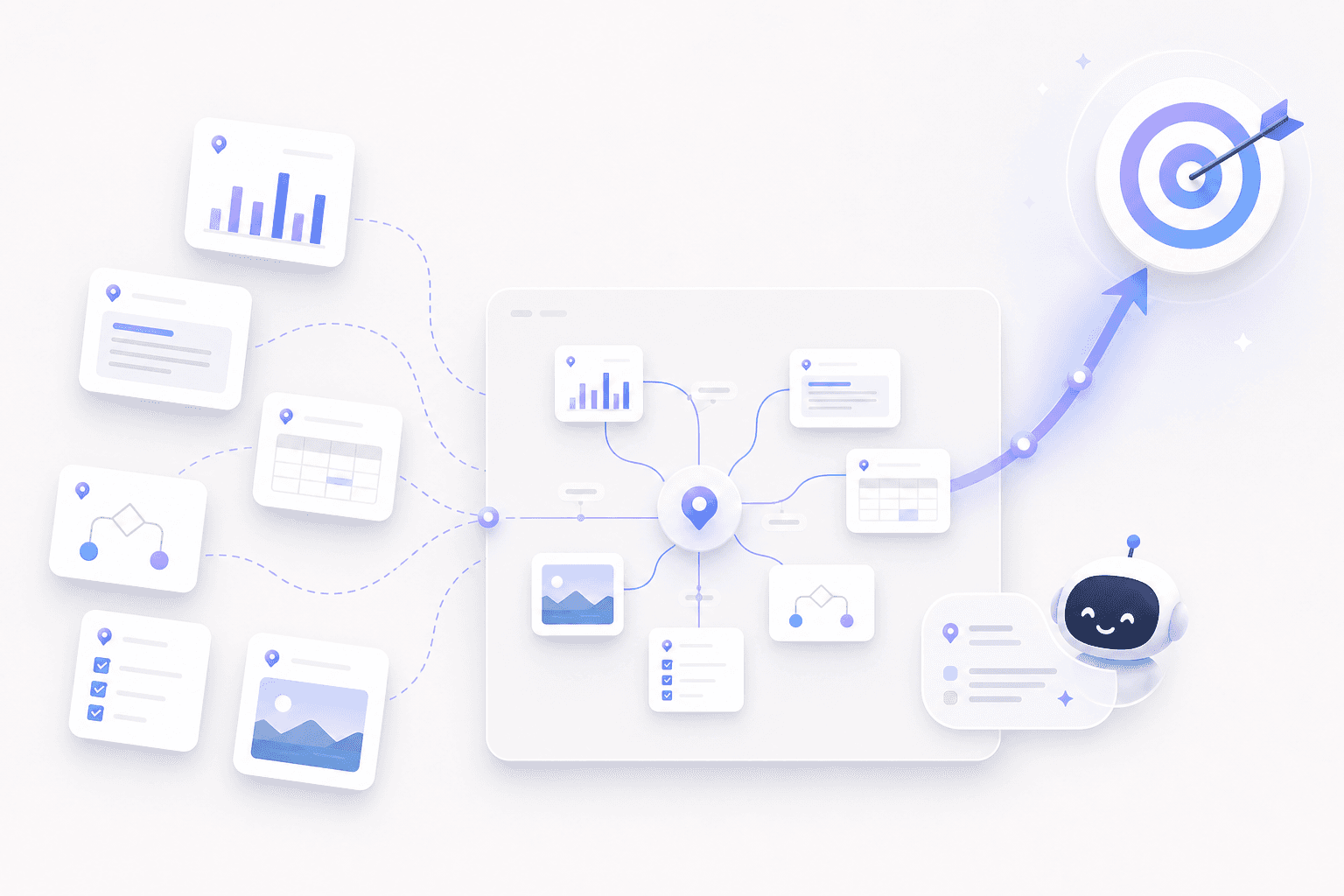
Thinking in pins: start with outcomes
A short guide to changing how you work in Pindown: think in outcomes first, then let pins become the reusable building blocks for pages, boards, showcases, pitches, and projects.
Most tools train you to think in files, folders, documents, or chat messages. Pindown works better when you start thinking in outcomes and pins.
Instead of asking, "Where should I put this information?", ask:
- What do I want to create?
- Who needs to understand it?
- What small pieces of information does the output need?
- Which pieces should be reusable later?
That shift is the difference between storing information and building an agentic workspace. Every format in Pindown is a composition of pins, so the better you define the building blocks, the easier it becomes to create pages, boards, showcases, pitches, projects, and canvases.
Start with the outcome
Begin with the result you want:
- a quick presentation
- a detailed Pitch
- a high-level Showcase
- a Canvas for brainstorming
- a Project workspace
- a Page that compiles information
- a Pinboard for review, comparison, and monitoring
- a Timeline for ordered events
- a single chart, table, brief, decision, or checklist
Once the outcome is clear, the pins become easier to define. The format is the container; the pins are the reusable pieces that make it useful.
Pins are reusable building blocks
A pin is not just something you save. It is a small, useful unit of work that can move across formats.
One pin can be:
- placed into a Page
- shown in a Showcase
- used in a Pitch
- collected on a Pinboard
- organized inside a Project
- referenced again later by the app-wide agent
This is why Pindown works best when you avoid creating giant one-off documents. Smaller pins give you more flexibility.
Let the agent assemble first
You can create everything manually, but the fastest way to work is to describe the outcome and let the app-wide agent create a first version.
Then you stay in the loop:
- review the result
- edit the pins
- move things around
- add missing context
- share or continue building
The agent does the heavy first pass. You guide, correct, and decide.
The practical rule
If you are unsure what to create, do not start by making a blank board. Start with a sentence:
"I want to create a [format] about [topic] for [audience]."
Examples:
- "I want to create a Pitch about our product roadmap for investors."
- "I want to create a Canvas for brainstorming a new feature."
- "I want to create a Page that summarizes this research."
- "I want to create Pins from this information so I can reuse and share them later."
That is the core habit: think in outcomes, let the workspace turn them into pins, then keep building on top of them.