Pindown vs Manus: who each product is for (and when to use what)
Manus is built around autonomous AI agents that run multi-step tasks; Pindown is a team workspace for pins, canvases, and shared narratives. Here’s a neutral take on fit—and how the two can complement each other.
Manus and Pindown get compared in search and conversation because both say “AI”—but they sit in different categories. Manus is closer to a general-purpose agent that executes work you delegate. Pindown is a workspace where teams build, track, scale, and share initiative truth as typed pins on canvases with people in the loop. This guide is about fit, not a scoreboard. (Manus’s product surface evolves quickly—treat feature specifics as “check their site.”)
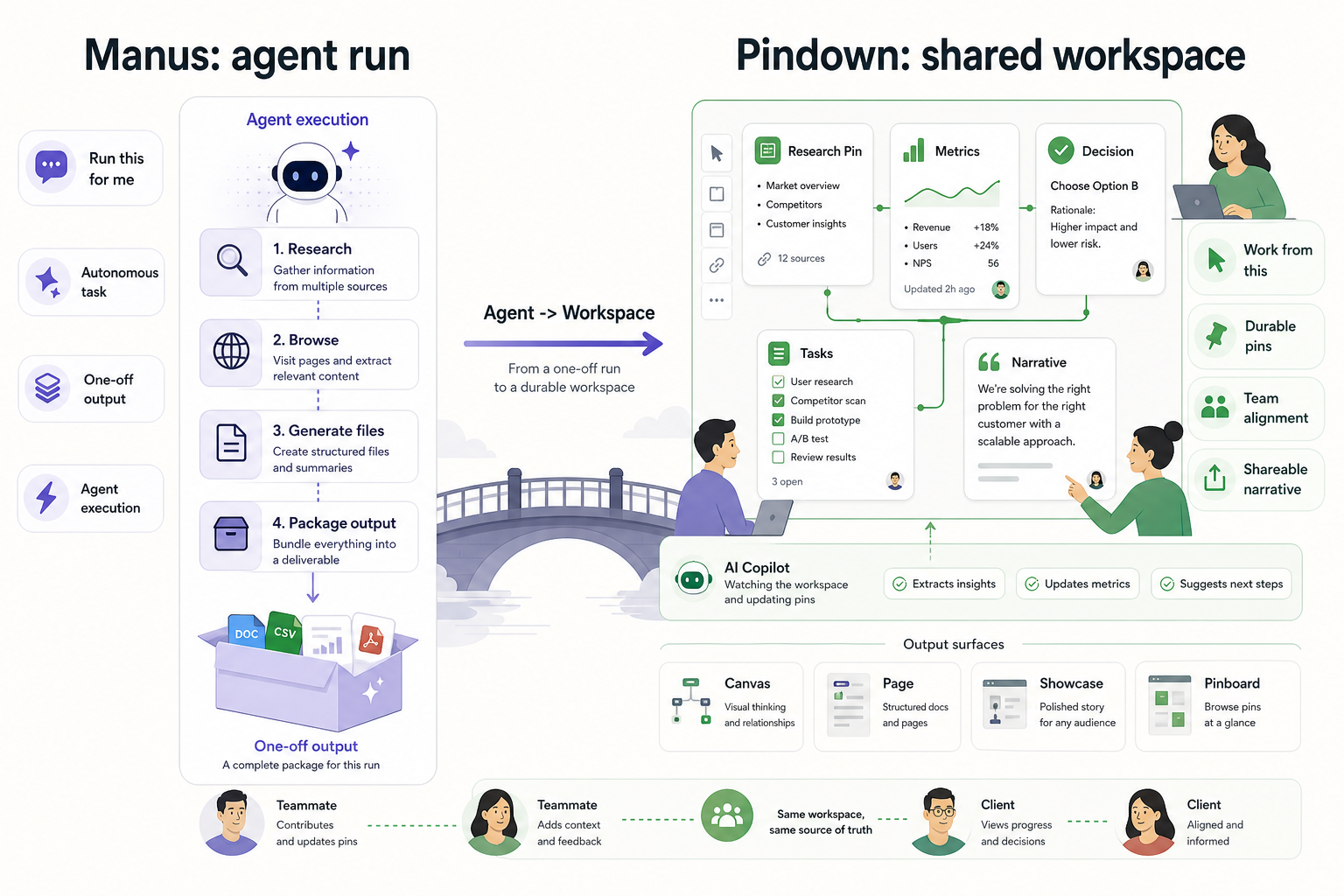
The whole package in one pass
| Manus (autonomous agent) | Pindown (pin-first workspace) | |
|---|---|---|
| Center of gravity | Run this for me—multi-step execution in a session or workflow | See this with my team—a shared surface of pins, metrics, and narrative |
| Primary “unit” | Task / run / deliverable the agent produces | Pin (table, chart, board item, JSON, markdown, etc.) you compose and reuse |
| Where the work lives | Often ephemeral runs, exports, and artifacts the agent returns | Durable canvases and projects meant to stay aligned week over week |
| Collaboration model | You steer an agent; outputs land for you first—sharing is downstream | Built for sharing: teammates and clients see the same structured board (with permissions) |
| AI’s job | Autonomously carry out steps (research, file work, builds—per what the product supports) | Workspace-native copilot: search, create, and update pins where your initiative already lives |
| Sweet spot | “Go investigate / organize / draft / build this end-to-end” | “Keep this initiative visible—brief + KPIs + board—in one place” |
Neither replaces the other by default—they solve different pains.
Who Manus is for
Manus tends to fit when your bottleneck is delegating execution:
- Research and synthesis runs where you want an agent to chain steps (gather, structure, produce).
- Personal or small-team automation: turning messy inputs into artifacts without building software yourself.
- Building or prototyping deliverables through agent workflows when that’s what the product emphasizes—especially if you’re OK with runs and outputs rather than a standing team board.
If your week sounds like “give the agent a mission, review what came back,” you’re in agent territory.
Who Pindown is for
Pindown fits when your bottleneck is shared clarity across people and formats:
- Product, consulting, ops, and client-facing teams shipping initiatives that appear as briefs, boards, metrics, and narratives in parallel.
- Teams that need two-level sharing: the whole canvas sometimes, specific pins other times—without retyping truth into five artifacts.
- Groups who want AI to mutate workspace objects (“update this pin”) tied to what stakeholders actually see.
If your week sounds like “everyone must point at the same pins before we ship the story,” you’re in workspace territory. Start with What is Pindown? and The atomic approach if the vocabulary is new.
When to use which
| Situation | Lean toward |
|---|---|
| You need a one-off or recurring agent run to produce an asset | Manus (or similar agents)—optimized for doing |
| You need a persistent initiative room that survives meetings | Pindown |
| Deliverable is files / builds / research packs for one owner | Agent-first makes sense |
| Deliverable is alignment: exec + IC + client seeing one structured surface | Pindown |
| You mostly chat to steer automation | Agent platforms shine |
| You mostly arrange pins + Ask AI inside a workspace | Pindown shines |
Using both (common pattern)
Many workflows are agent → workspace:
- Use an agent run to compress research, clean a dataset, or draft a first pass.
- Pin the outcomes in Pindown so the team argues with the same numbers and blocks—not a one-off export lost in chat.
The split is: Manus (or any agent) for the run; Pindown for the room where the story stays accountable and shareable.
A quick smell test
- Is success defined by “the agent finished” or “the team agrees on what’s on the board”?
- Will this artifact live for weeks with multiple audiences? → Workspace-first.
- Is this mostly private execution or client/teammate visibility? → Visibility pushes you toward a shared canvas.
- Do you need permissions and narrative side-by-side? → Pindown-shaped work.
Frequently Asked Questions (FAQ)
Is Manus a Pindown competitor?
Not in the traditional sense. Manus competes with other autonomous agent experiences; Pindown competes with doc/deck sprawl for initiative storytelling. You might use neither, one, or both.
Can we use Manus and Pindown together?
Yes—agent for the heavy run, Pindown for the shared, durable layer the team and clients actually work from.
How is this different from the Notion comparison?
Notion vs Pindown is about page-first vs pin-first habits. This article is about agent-first execution vs team workspace—a different axis.
What should I read next on Pindown?
- AI-native workspace — build, track, scale, share
- Pindown vs Notion — when to use what in the doc stack