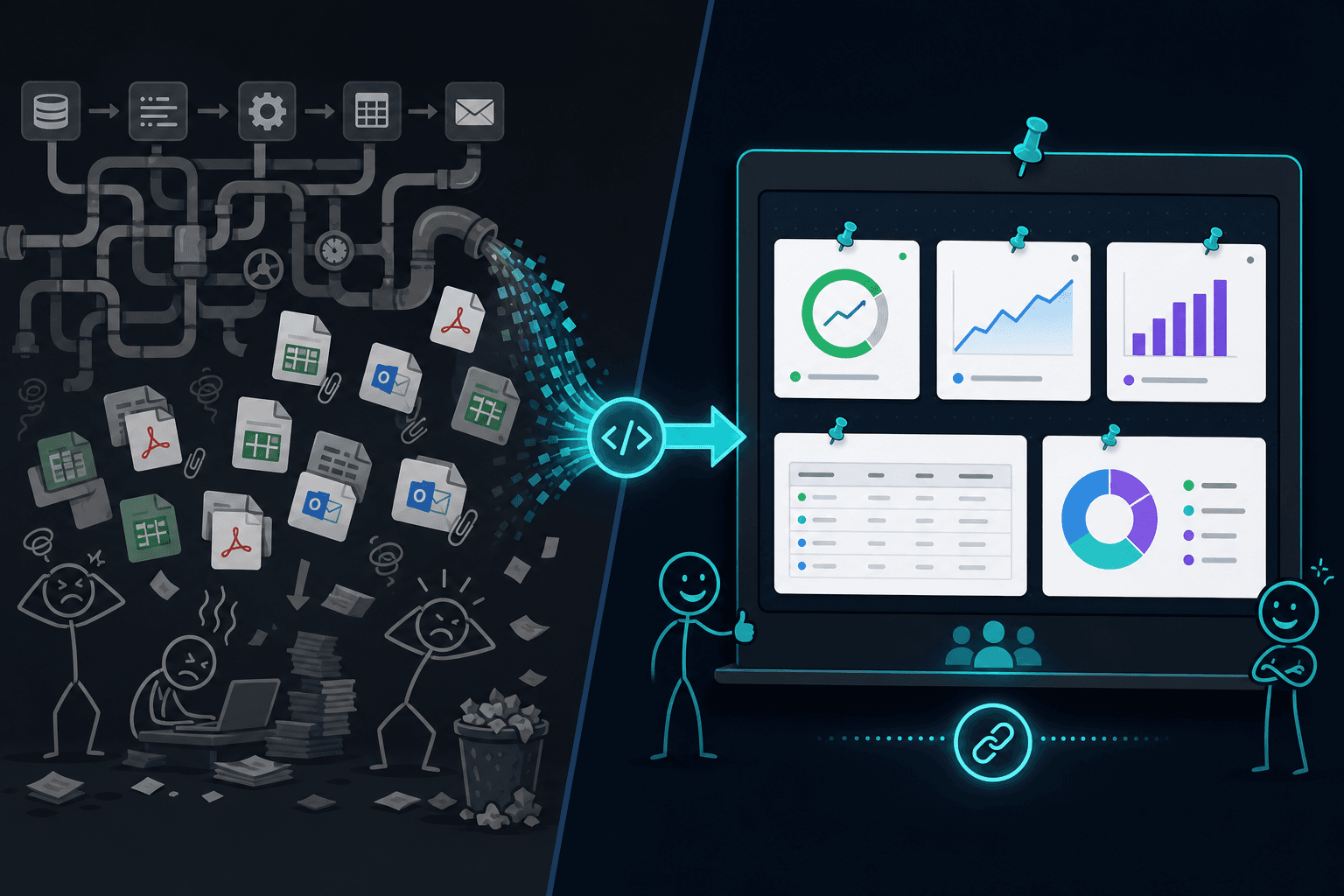
Sharing automation output without attachment chaos
Your pipeline already ran. Sending Dashboard_v7_FINAL.pdf every morning is a habit—not a requirement. Share one live link that updates in place and ends the “which version is right?” thread.
Short answer: When agents, cron jobs, or ETL finish, share a pin—not another attachment. Stakeholders open one bookmarked link; the next run updates the same objects. No Q4_Actuals_FINAL_v3 (1).xlsx archaeology. No Slack thread asking "is this the latest?"
- Pleasant for recipients: one URL, always current, readable on any device
- Pleasant for operators: change the delivery step, not the whole data stack
- Same surface for humans and automation: narrative, KPIs, and checklists in one Pinboard or Pitch
The version chaos you already know
Monday morning. Fourteen people. Three filenames that all sound official:
Weekly_KPIs_FINAL.pdfWeekly_KPIs_FINAL_v2.pdfbreakdown_March_REAL.xlsx
Someone copied a row into a personal sheet "just to annotate." Leadership is presenting from a deck exported yesterday. The warehouse was right at 04:00. The communication layer failed by 09:30.
That is not a data problem. It is a delivery format problem—and it gets worse every time you automate more.
What pleasant sharing actually looks like
Pleasant sharing means:
- You send the link once—Pinboard for ops, Pitch tab for a client, single stat card in a standup doc.
- The next pipeline run PATCHes the pins in place. Recipients do not download anything new.
- Story and numbers stay together—the markdown brief explaining why MRR moved sits beside the stat card that moved.
- A human can fix a label or add a comment without redeploying the job. Only values change when data changes.
That is the opposite of inbox-driven reporting, where every run creates a new artifact and hope someone finds it.
Agents and pipelines belong on the same objects
Whether output comes from n8n, dbt + Python, Airflow, or a Mastra workflow, the last mile should land on typed pins your team already opened—not in a folder nobody trusts.
Every pin is an endpoint. Your automation POSTs or PATCHes structured JSON; stakeholders read the same address in the browser. See What makes Pindown different for the workspace model and Every pin is an endpoint for the technical spine.
Start here
| If you want… | Read… |
|---|---|
| The full anti-PDF / anti-Excel case | Stop sending pipeline output as PDFs and Excel |
| The Monday deck rebuild ritual | Stop rebuilding the weekly status deck |
| Agent runs that nobody can find on Tuesday | Agent output shouldn't die in Slack and logs |
| n8n → live dashboard | Best dashboard wrapper for n8n |
| Spreadsheet rows → stat cards | Turn spreadsheet metrics into stat cards |
| Client-facing self-updating tabs | Pindown Pitch format |
Frequently Asked Questions (FAQ)
Do we have to stop using PDFs entirely?
No. PDFs are fine for frozen legal snapshots or auditor sign-off. Do not make them the live interface for a team that needs current numbers.
Is this only for data teams?
No. Any recurring agent output—research digests, launch checklists, competitive tables—benefits from one live link instead of a daily export.
What changes on day one?
Usually only the last mile: file/email → pin API. Keep your warehouse, orchestrator, and transforms.
What should I read next?
- Stop sending pipeline output as PDFs and Excel — stack patterns and smell test
- Stop rebuilding the weekly status deck — end the Monday export theater
- Agent output shouldn't die in Slack and logs — durable surfaces for runs
- Why Pindown saves time — AI-to-Asset pipeline
- Pindown Pinboards — monitoring surfaces for ops