Stop rebuilding the weekly status deck
The data is already in your warehouse. So why does someone still spend Monday morning screenshotting Grafana, pasting into Slides, and emailing Leadership_Update_v14.pptx? One live Pinboard beats the weekly rebuild ritual.
Short answer: If your numbers change during the week, a slide deck is the wrong interface. Stop treating Monday as "export theater"—pin the KPIs, checklist, and narrative on a Pinboard or Pitch tab, share the link once, and let automation PATCH the pins before standup.
- Kill the Monday rebuild: no screenshot → paste → reformat → "quick tweaks" loop
- One surface for leadership and ops: metrics beside risks, not split across five tools
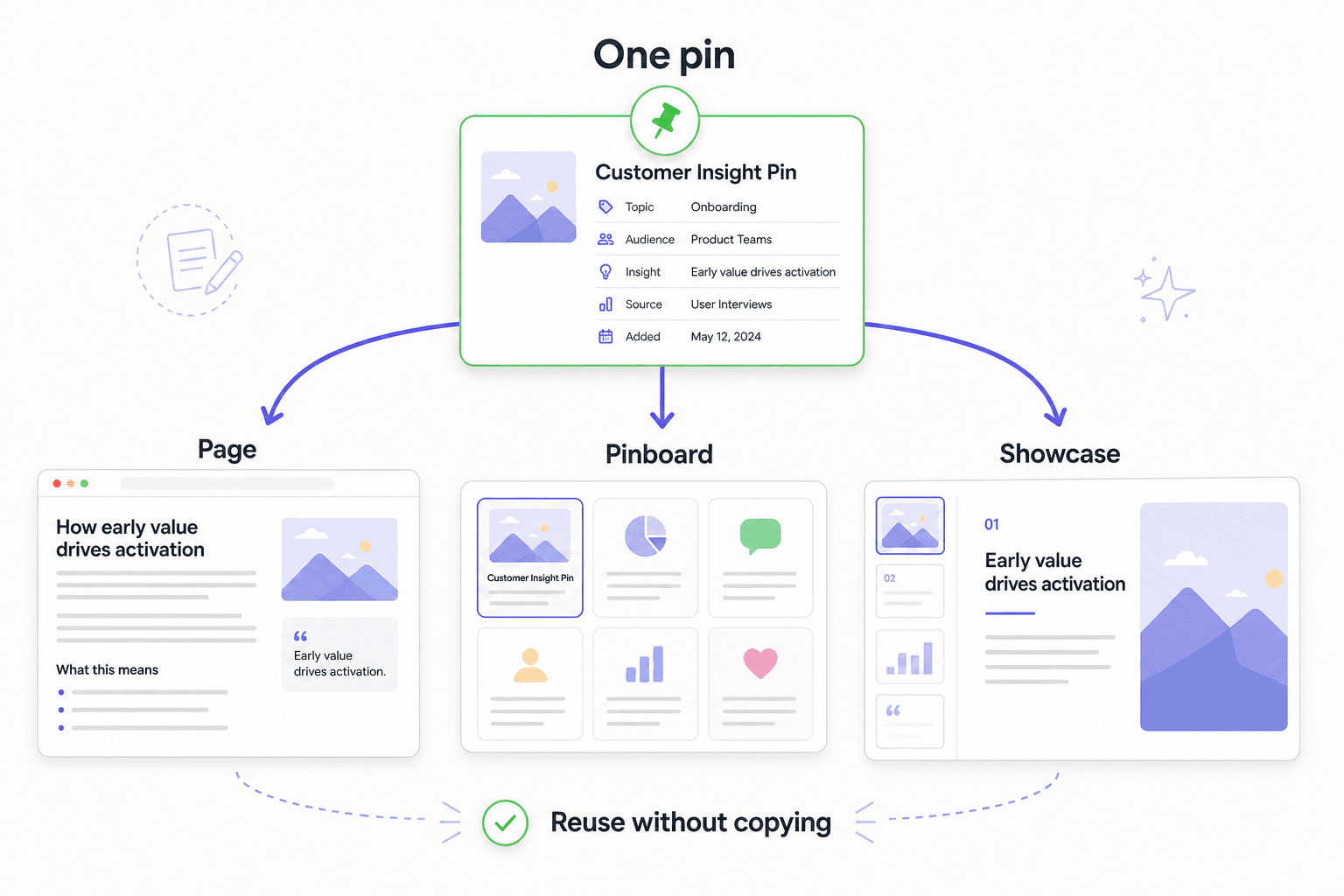
- Same pins in multiple formats without re-authoring the deck every sprint
The Monday ritual everyone pretends is fine
It starts the same way every week:
- 08:30 — Ops opens BI, exports a CSV "just for the deck."
- 09:00 — Someone screenshots Grafana because the chart "doesn't paste right."
- 09:45 — The PM copies bullet points from last week's Slides and edits verbs.
- 10:30 — A Slack message: "Deck ready—numbers as of yesterday EOD, right?"
- 14:00 — Leadership asks about a metric that moved at lunch. The deck is already wrong.
Nobody lied. The format expired the moment it left the building. You paid for a warehouse and pipelines—but the last mile is still a human assembling a static snapshot for people who need a live view.
Decks are presentations—not systems of record
| Surface | Good for… | Terrible as… |
|---|---|---|
| Slide deck | A live meeting walkthrough | Canonical KPIs that change daily |
| BI dashboard | Analysts drilling down | Narrative + tasks + client context in one place |
| Slack summary | Alerting | Something you trust in Q3 planning |
| Notion page | Long-form docs | Auto-updating ops metrics |
Teams keep rebuilding decks because decks are familiar—not because decks are correct. The chaos is structural: every week you manufacture a new artifact instead of maintaining one address everyone already bookmarked.
What replaces the rebuild
You do not need a fancier template. You need pins that already mean something:
Loading checklist...
Put them on a Pinboard for internal leadership—or a Pitch tab for clients. Write the markdown brief once as a pin beside the numbers. When MRR moves, your job or agent updates the stat card; the brief stays in context.
That is not "we stopped using slides." It is we stopped re-exporting truth into slides every Monday to answer questions a link could answer all week.
The five-place update problem
The deck is often only the visible symptom. The same week, someone also:
- posts a summary in #leadership-updates
- pastes rows into a tracking spreadsheet
- updates a Notion "source of truth" page
- attaches a PDF for the board
Five surfaces. Five chances to be slightly wrong. By Wednesday, nobody agrees which number is official.
Pindown collapses that: one Pinboard (or Pitch) is the canonical surface. Automation writes the metrics; humans edit narrative and checklists in place. Slack becomes a pointer ("updated—same link"), not a second database.
How to break the habit this week
- Pick one recurring review (weekly ops, client QBR, product council).
- Create three pins: headline stat cards, one detail table, one risk/checklist.
- Share the board link in the calendar invite—retire the attachment.
- Wire one metric from your existing pipeline or spreadsheet flow (how-to).
- Ban "I'll update the deck tonight" from the runbook. Update the pin.
Frequently Asked Questions (FAQ)
Do we still use slides in live meetings?
Yes. Present from the live Pinboard or Pitch—or snapshot a tab for a keynote. The difference is you are not maintaining a parallel deck as the system of record.
What if leadership insists on PowerPoint?
Export when you need a frozen board packet. Do not make PowerPoint the live interface for metrics that change daily.
Is this only for startups?
No. Any team with a recurring "status ritual"—agency client reports, infra reviews, portfolio updates—pays the same tax.
What should I read next?
- Sharing without attachment chaos — live links vs inbox hell
- Stop sending pipeline output as PDFs and Excel — automate the last mile
- Pindown Pitch format — client-facing tabs that stay current
- What makes Pindown different — planning beside live data